



How LookingPoint brings production discipline and engineering flexibility to complex rack deployments
AI infrastructure is changing quickly.
Much of the conversation focuses on GPUs, power density, cooling and the enormous amount of data center capacity being built.But another change is happening behind the scenes.
The way infrastructure is being integrated is changing too.
Oracle recently reported delivering 850 MW of additional datacenter capacity and more than 300,000 GPUs to customers since the end of its previous quarter. Separately, Amazon and Wiwynn announced an expansion of their Texas facility that manufactures and integrates server systems and complete racks.
The scale is significant. But there is a simpler takeaway for organizations deploying AI infrastructure at any scale.
As AI deployments grow, rack integration has to become more repeatable, more measurable and easier to scale.
For customers, the question is no longer only what belongs in the rack. It is how to build the same complex system again and again without turning every rack into a new project.
AI Did Not Create This Model. It Is Making It More Important.
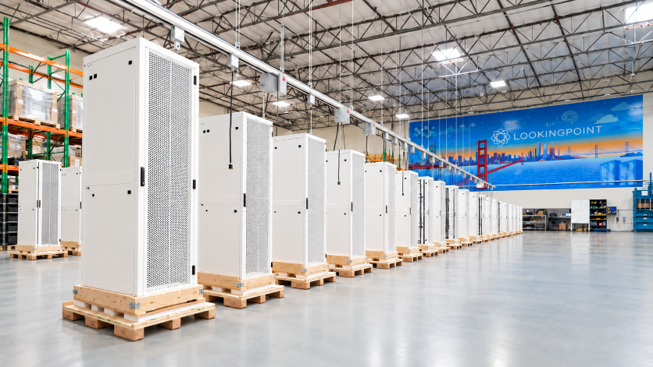
For more than 10 years, the LookingPoint Integration Center has used an assembly line style approach for larger rack builds and repeat customer deployments. AI did not create the need for this model. It is making the model more important.
The concept is straightforward.
Build the first rack. Dial in the process. Establish the standard. Then repeat it.
When a customer needs multiple racks built to the same specification, treating every rack as an individual project creates unnecessary variation. A repeatable process creates consistency.
As the equipment inside the rack becomes more complex and valuable, that consistency becomes increasingly important.
Building One Rack Is a Project. Building 20 Is a Process.
A modern rack can bring together equipment from multiple manufacturers: compute, networking, storage, power, cabling and, increasingly, liquid cooling infrastructure.
Each component can have its own installation requirements, serial number, rack position, firmware, cabling, power requirements and validation steps.
Now repeat that across an entire deployment.
The challenge is no longer simply whether the team can build a rack. The challenge is whether Rack 20 can be built with the same consistency as Rack 1.
That requires a different approach.
Design the Build for Repeatability
For larger deployments, the first rack becomes more than a finished product. It becomes the reference point for what follows.
Equipment placement, cabling standards, assembly sequence, configuration requirements, quality checks and packaging can be established before the remaining racks move through the build.
Once the process is dialed in, technicians are not reinventing the rack each time. They are following a defined build standard.
That is where an assembly line style Integration Center provides a different kind of value: the discipline to build repeatedly, with the engineering flexibility to adjust when the deployment requires it.
|
ENGINEER |
BUILD |
VALIDATE |
DOCUMENT |
DEPLOY |
Production Discipline Without Factory Rigidity
Not every AI or high density infrastructure deployment requires thousands of identical racks.
A customer may need 10 racks, 30 racks or 50 racks. The configuration may span several manufacturers. The first rack may need to be reviewed before the remaining builds move forward. Components or deployment schedules may change along the way.
That creates an important space between a one off custom rack build and hyperscale manufacturing.
That is where the LookingPoint Integration Center fits.
Customers can work with our team to establish the initial design, validate the first build, make adjustments and then move into a repeatable build process. The goal is to gain consistency at scale without giving up the ability to adapt.
The Build Record Is Becoming Part of the Rack
As rack value and complexity increase, physical integration is only part of the job. Documentation and traceability become part of the build.
Which serial number was installed? Where was it installed? Was the correct firmware loaded? Was the cabling verified? Did the rack pass QA? Were there exceptions during the build?
For complex deployments, those answers should be captured as the work happens rather than reconstructed at the end.
As these deployments evolve, a serialized digital build record can bring component information, rack position, test results, firmware, QA approvals and turnover documentation together around the individual rack.
The direction is simple: one rack, one build record and a clearer path from integration to deployment.
Quality Becomes Part of the Process
When a rack contains high value infrastructure, quality assurance cannot happen only at the end.
Component verification, rack position, cabling, power, firmware, configuration and testing can be built into the workflow. For certain configurations, defined hold points can also be established before critical steps such as initial power, final packaging.
The objective is not simply to confirm that the finished rack looks correct.
It is to know how it was built and how it was verified.
From Build Floor to Data Center
Completing the rack is only part of the deployment.
The finished system still has to be documented, protected and delivered to the customer location. Completed racks can be prepared for transportation based on the equipment and deployment requirements, then coordinated to arrive when the site is ready.
Instead of receiving individual components that still need to become a system, the onsite team receives integrated infrastructure prepared for final installation.
That means less assembly at the destination and more focus on getting the environment operational.
The LookingPoint Integration Center
The LookingPoint Integration Center is not simply a place to assemble racks.
It is where complex infrastructure becomes repeatable before it reaches the datacenter.
For more than a decade, our team has supported larger customer builds using assembly line style processes designed around consistency, quality and deployment readiness.
AI is increasing the scale, density and complexity of infrastructure. That makes the process behind the rack more important than ever.
Whether the deployment involves networking, compute, storage, power, cooling or a combination of technologies from multiple manufacturers, LookingPoint can help turn a rack design into a controlled, repeatable deployment process.
AI is changing what goes into the rack and how quickly organizations need to deploy it. The value of a disciplined, flexible integration process is becoming more important with it.
Planning an AI, high-density or large-scale rack deployment?
If you are interested in our Integration Services please contact us at Sales@lookingpoint.com and we will reach out to you with further information.
Raj Sandhu, Director of Integration